The art department
Much of the creature and character design for the 1984 film ran through a small group of illustrators. Storyboard and concept artist Thom Enriquez produced a large body of the surviving Ghostbusters concept art, including approved and unused designs for the Terror Dogs, Gozer, and Stay Puft.1 Other contributors named in the production record include John Daveikis, who drew creatures to accompany Dan Aykroyd's original script, and Robert Kline, who supplied alternate concepts.1 Associate producer Michael C. Gross oversaw the visual direction of the film, and Berni Wrightson contributed exploratory designs for Gozer's monstrous forms.2
Terror Dog designs
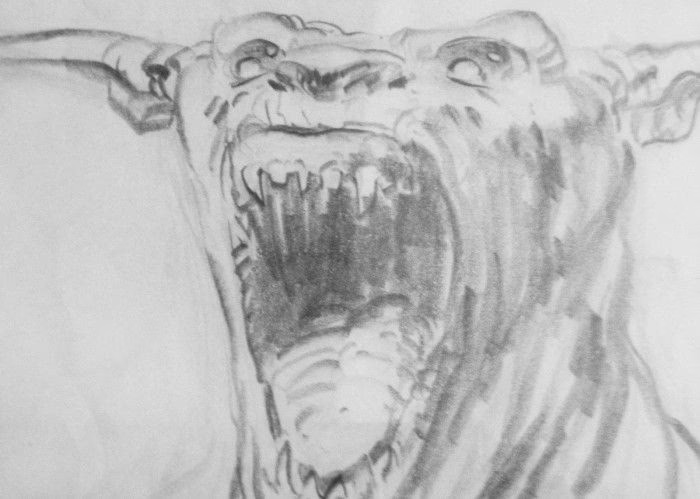
The Terror Dogs went through more design variation than almost any other creature in the film, and the surviving sketches document that back and forth. Early drawings ranged widely: John Daveikis designed a spiny hammerhead creature for Aykroyd's original script, Thom Enriquez conceived a lumbering, dim-witted creature, and a Robert Kline concept made the creature look like a dragon. The team went back and forth over whether the design should be humorous, horrific, or both.1
Enriquez ultimately drew the approved look. Kurt Conner made the preliminary sculpture from the sketch, and the concept was then handed to sculptor and stop-motion animator Randall William Cook.1 Cook found the maquette based on Enriquez's concept too cartoonish to animate and submitted his own, more anatomically grounded design, which became the version used in the film.1
The following storyboard pieces are original Ghostbusters preproduction concept art featuring the Terror Dog:

Stay Puft and Gozer
Concept work for the Stay Puft Marshmallow Man survives from several hands. John Daveikis illustrated a Stay Puft drawn from the original script, and Thom Enriquez produced a set of Stay Puft concepts that are reproduced in published behind-the-scenes books.1 In the concept phase, Enriquez also explored an alternative to the marshmallow man: a monster based on Ray's pet lizard from his childhood.3
The Gozer design passed through more drastic conceptual variations than any other creature in the film. Aykroyd's script described the character as looking like Bert Parks; later thinking moved toward an androgynous rock-star figure in the vein of David Bowie or Grace Jones, the idea that the finished form retains.2 Early brainstorming treated the Stay Puft marshmallow man as an interdimensional form that Gozer would assume on the way to becoming something larger and more horrific, and Berni Wrightson's drawings explored that transformation.2
Storyboards
Beyond character design, the surviving art includes storyboards that laid out specific sequences. When Thom Enriquez storyboarded the Zuul sequence, he drew one of the Terror Dog's arms in two positions with cartoon-style motion lines to show movement. The drawing was misread by the model crew, a detail Michael Gross later recounted when explaining how the production worked from these boards.4
Enriquez returned for Ghostbusters II (1989). To bring the Scoleri Brothers to life, Ivan Reitman and Gross turned to him to lay out the basic action of the scene before the effects work began.5
Sources
Many of these drawings are reproduced in two published references that are the basis for most of the facts on this page: Don Shay's behind-the-scenes book on the first film, and the later illustrated history by Daniel Wallace. Original Enriquez illustrations for the Terror Dogs and Stay Puft have also surfaced through auction houses.
References
-
Shay, Don, Making Ghostbusters, p. 116-117 annotations. New York Zoetrope, 1985, ISBN 0918432685.
-
Shay, Don, Making Ghostbusters, p. 155, 180 annotations. New York Zoetrope, 1985, ISBN 0918432685.
-
Wallace, Daniel, Ghostbusters: The Ultimate Visual History. Insight Editions, 2015.
-
Shay, Don, Making Ghostbusters, p. 112 annotation (Michael Gross). New York Zoetrope, 1985, ISBN 0918432685.
-
Eisenberg, Adam, "Making Ghostbusters II," Cinefex #40, p. 13, 1989.
